How to Handle Difficult Questions in Executive Meetings.

By Jeffrey Davis | Speak Clear Communications
You have prepared the presentation. You know the numbers. Then a board member asks, “Why should we believe this forecast when we missed the last one?”
Suddenly, the slides are beside the point.
For senior executives, public speaking includes moments like this: a skeptical question, an unexpected objection, or a request for a decision before all the information is available.
To handle difficult questions well, listen for the concern, give a direct answer, explain what supports it, and make uncertainty explicit.
Preparing for that exchange deserves its own place in your calendar.
Why spontaneous speaking deserves preparation
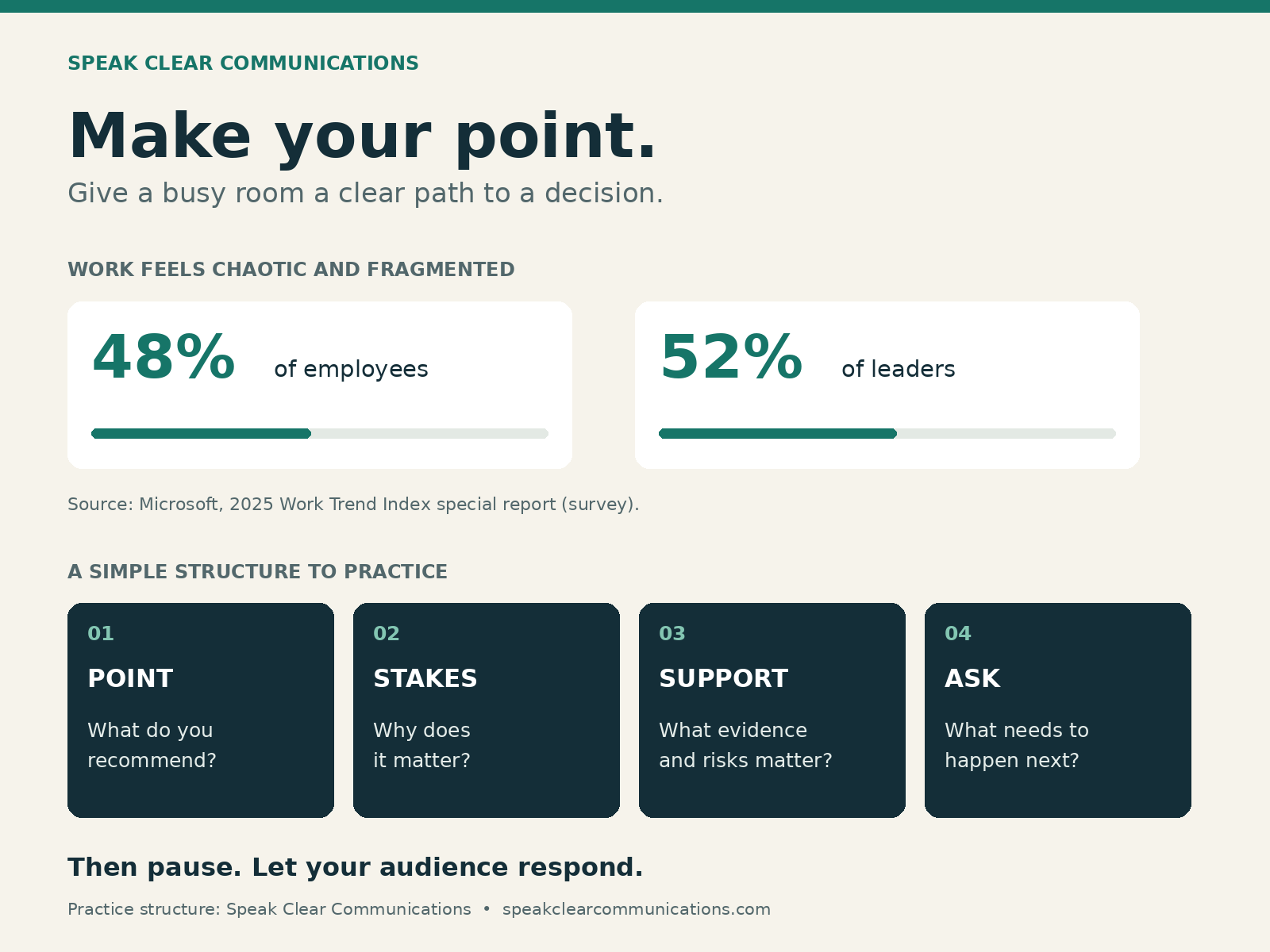
Microsoft’s 2025 report, Breaking Down the Infinite Workday, reports in its methodology that 60% of meetings were unscheduled or ad hoc among the top 20% of users by meeting volume. Its telemetry covered Microsoft 365 activity through February 15, 2025, excluding education and EU tenants.
That is not a statistic about every executive’s calendar. It does illustrate how much communication can happen outside a carefully prepared presentation.
The same report found that PowerPoint edits increased 122% in the final ten minutes before a meeting. Those findings do not measure speaking ability, but they raise a useful preparation question: How much time are you spending polishing the deck, and how much practicing the conversation that follows?
Listen for the concern before composing the answer
“Why did we miss the target?” could be a question about forecasting, accountability, or whether the current plan is credible. Let the person finish. If the question is ambiguous, clarify briefly: “Are you asking about what caused the shortfall, or what we’ve changed in this forecast?”
If it is already clear, answer it. Repeating and reframing every question can sound evasive.
In his Stanford Graduate School of Business article on more confident and compelling presentations, Matt Abrahams recommends approaching speaking as service to the audience’s needs. That is a useful shift during a challenging exchange: focus on what the listener needs to understand.
Give your answer a structure you can use under pressure
You do not need a memorized paragraph for every possible objection. You need a dependable way to organize your thinking.
Abrahams discusses the “What? So what? Now what?” framework in Stanford’s Tips for Speaking Up in Virtual Meetings. For executive Q&A, those questions can help you identify the situation, its significance, and the next step.
Here is a fictional response to that skeptical board member:
“The previous forecast overestimated how quickly two large contracts would close. This forecast excludes both until they are signed, which lowers the projection but makes the assumption more conservative. We’ll review the pipeline weekly and flag any further change.”
The response acknowledges the miss, explains what changed, and names the follow-through. The listener can now evaluate the reasoning.
For more on organizing the message itself, see Concise Executive Communication: How to Make Your Point.
Make the limits of your knowledge clear
Sometimes the strongest answer begins, “I haven’t confirmed that.”
Follow it with something useful:
“I haven’t confirmed the implementation cost. We have the vendor estimate, but internal staffing is still being assessed. I’ll send the combined figure by Thursday.”
Distinguish facts from estimates and recommendations. If you offer a provisional judgment, identify the assumption behind it. A confident delivery should help listeners understand how certain you are.
Practice the words that carry the decision
Delivery matters most where a misunderstanding would change the meaning: numbers, dates, qualifications, and commitments.
Try this sentence aloud:
“We can launch in November, provided the security review is complete.”
Pause briefly before the condition. Give “provided” enough emphasis that the qualification is audible.
For multilingual executives interested in accent modification, useful practice can begin with the language of their actual work: recurring technical terms, client names, important word endings, and phrases used in questions and answers. Choose targets based on where listeners have difficulty understanding you.
An accent alone does not tell you whether someone is clear or effective. As I discuss in Clear Communication Is Not About Sounding Perfect, coaching should support your message while preserving your individual voice.
Rehearse the exchange, including the follow-up
Before your next important meeting, set aside ten minutes:
- Write three questions you would least like to receive.
- Answer each aloud, including relevant evidence and uncertainty.
- Ask a colleague to choose one answer and challenge its weakest assumption.
- Listen to a recording for one thing: Did you address the question directly?
- Repeat the answer with one useful change.
This is a practice exercise, not a scientifically established time requirement. Its purpose is to make room for the part of the meeting your slides cannot rehearse.
Prepare for your next high-stakes conversation
At Speak Clear Communications, I help executives and professionals develop clearer speech, stronger public speaking skills, and more effective presentations. Coaching can include difficult Q&A, vocal presence, articulation, and accent modification tailored to your goals.
Schedule a free consultation with Jeffrey Davis to discuss the conversations you want to handle more effectively.