Public Speaking in the Age of AI: Why Your Human Voice Matters More Than Ever.
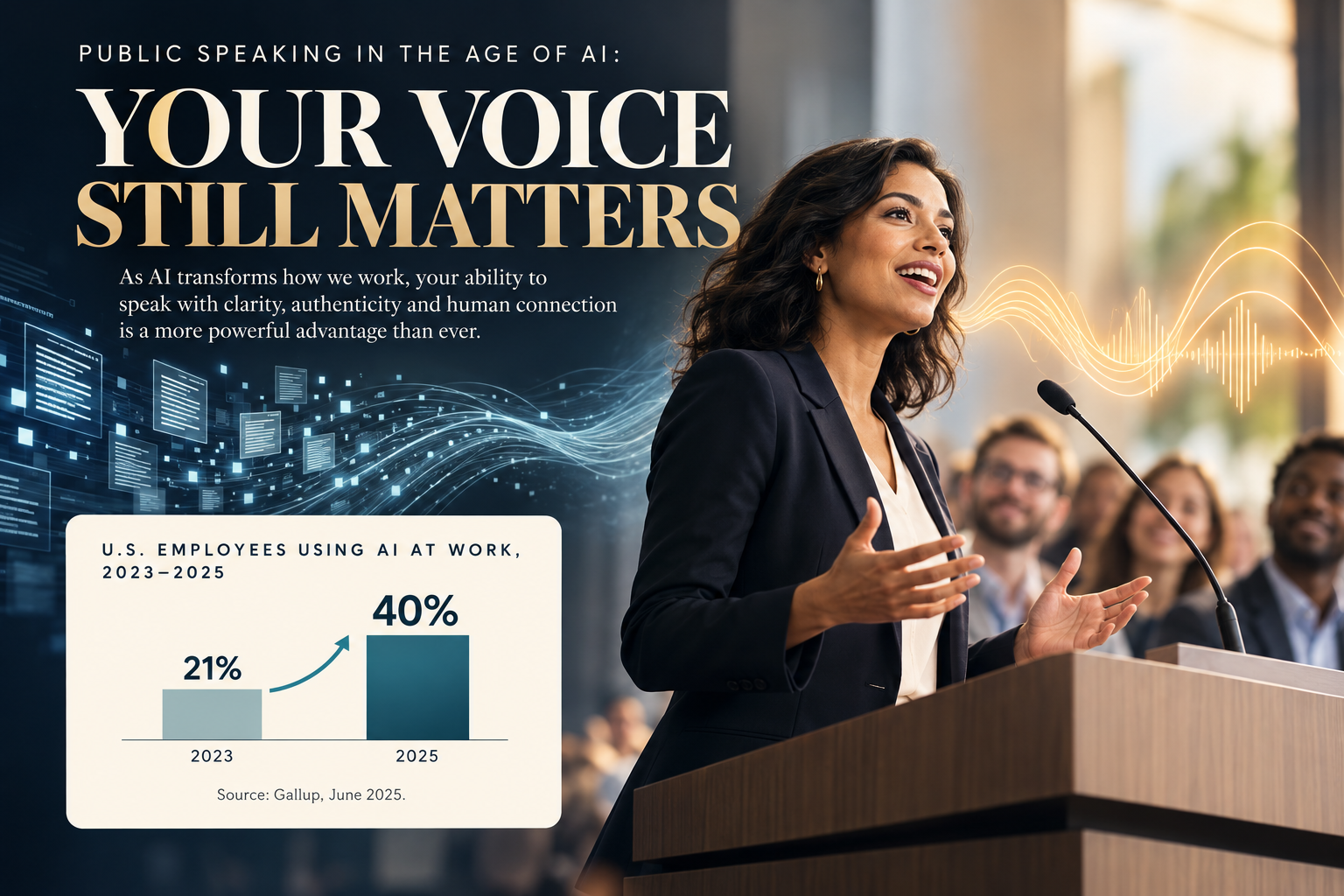
AI can write your speech. But can it help you connect with your audience?
Artificial intelligence is transforming the way professionals communicate. In seconds, AI can generate a presentation outline, write a persuasive opening, summarize a complex report, or produce an entire speech.
But there's an important distinction between producing words and communicating effectively.
As AI-generated content becomes increasingly commonplace, the ability to speak naturally, confidently, and authentically may become one of the most valuable professional skills you possess.
The Numbers Tell an Interesting Story
According to Gallup, the percentage of American employees using AI at work at least occasionally nearly doubled between 2023 and 2025, rising from 21% to 40%.
Yet a separate 2026 Gallup survey found that only 27% of Americans trust businesses to use AI responsibly.
These findings don't tell us whether audiences prefer human-written speeches. They do, however, reveal an interesting tension: AI is becoming part of everyday professional life, even as questions about trust remain.
And trust is at the heart of effective public speaking.
The Problem With the Perfect AI-Generated Speech
Imagine two executives delivering the same quarterly update.
The first reads a polished, meticulously structured presentation generated largely by AI. Every sentence is grammatically correct. Every transition is seamless. But the delivery feels rehearsed, detached, and impersonal.
The second executive speaks conversationally. She pauses to emphasize an important point, shares a brief personal observation, and makes genuine eye contact with her audience.
Who is more likely to hold your attention?
The second speaker has something the first may be missing: a sense of personal ownership. The difference isn't necessarily the writing. It's the connection between the speaker, the message, and the audience.
Five Ways to Make Your Public Speaking More Human
1. Speak from ideas, not scripts.
Rather than memorizing every sentence, organize your presentation around a few essential ideas. Know what you want your audience to understand, remember, or do.
A clear structure gives you the freedom to sound conversational.
2. Let your voice do some of the work.
Effective speakers vary their pace, pitch, volume, and emphasis. These vocal changes help communicate meaning and maintain attention.
Try reading an important sentence aloud three different ways. Notice how changing the emphasis changes the message.
3. Rediscover the power of the pause.
Many professionals rush through presentations because they're uncomfortable with silence.
But a well-placed pause gives your audience time to absorb an idea. It also gives you time to breathe, think, and reconnect.
Silence isn't necessarily a sign of uncertainty. Used deliberately, it can communicate confidence.
4. Make room for your own experience.
AI can generate examples, but it hasn't lived your professional life.
A brief, relevant story about a challenge, a decision, or a lesson learned can give a presentation specificity and emotional resonance. Your experience is an important part of your authority.
5. Practice out loud, not just on the page.
A speech that looks elegant on a screen may sound awkward when spoken.
Read your presentation aloud. Better yet, practice explaining your central ideas without looking at the script.
Ask yourself: Does this sound like something I would actually say?
If not, revise it.
How to Use AI Without Losing Your Voice
AI can be a useful preparation partner. Ask it to organize complicated information, identify unclear passages, or generate challenging questions your audience might ask.
Then take ownership of the material.
Remove language that sounds unnatural. Replace generic examples with genuine experiences. Practice until the ideas feel like your own.
The goal isn't to compete with AI. It's to use AI while preserving what makes your communication distinctly human.
Your Voice Is Still Your Greatest Communication Asset
Technology will continue to change how speeches are written, meetings are prepared, and presentations are delivered.
But strong communication still requires human judgment, empathy, clarity, and presence.
At Speak Clear Communications, we help professionals develop those skills through individualized executive speech coaching, vocal training, and practical presentation techniques.
Because delivering a great presentation isn't simply about finding the right words.
It's about bringing those words to life.
Ready to develop a more confident, authentic speaking voice?
Schedule a consultation with Speak Clear Communications
Jeffrey Davis is the founder of Speak Clear Communications, providing individualized executive speech coaching, public speaking training, and communication development for professionals.
Sources
- Gallup: AI Use at Work Has Nearly Doubled in Two Years (June 2025)
- Gallup: Americans Cool Toward AI (2026)