
Concise Executive Communication: How to Make Your Point
You know your material. You have the experience. Then someone in a leadership meeting asks, “What do you recommend?” and your answer starts three steps before it needs to.
You explain the history. You qualify the options. You supply another example. Somewhere along the way, your recommendation disappears.
Concise executive communication means making your main point easy to identify, giving the evidence your audience needs, and stating the next step. To speak more concisely in meetings, lead with your answer, explain why it matters, offer the most relevant support, and make a clear request. Then pause.
This is a skill you can practice without changing your personality or stripping the nuance out of your thinking.
Why clear executive communication matters now
LinkedIn’s 2026 Skills on the Rise report identifies executive and stakeholder communication as an increasingly important skill area, including public speaking and communicating through uncertainty. Its findings draw on growth in skills added to profiles and skills held by recently hired members—not search traffic or coaching purchases.
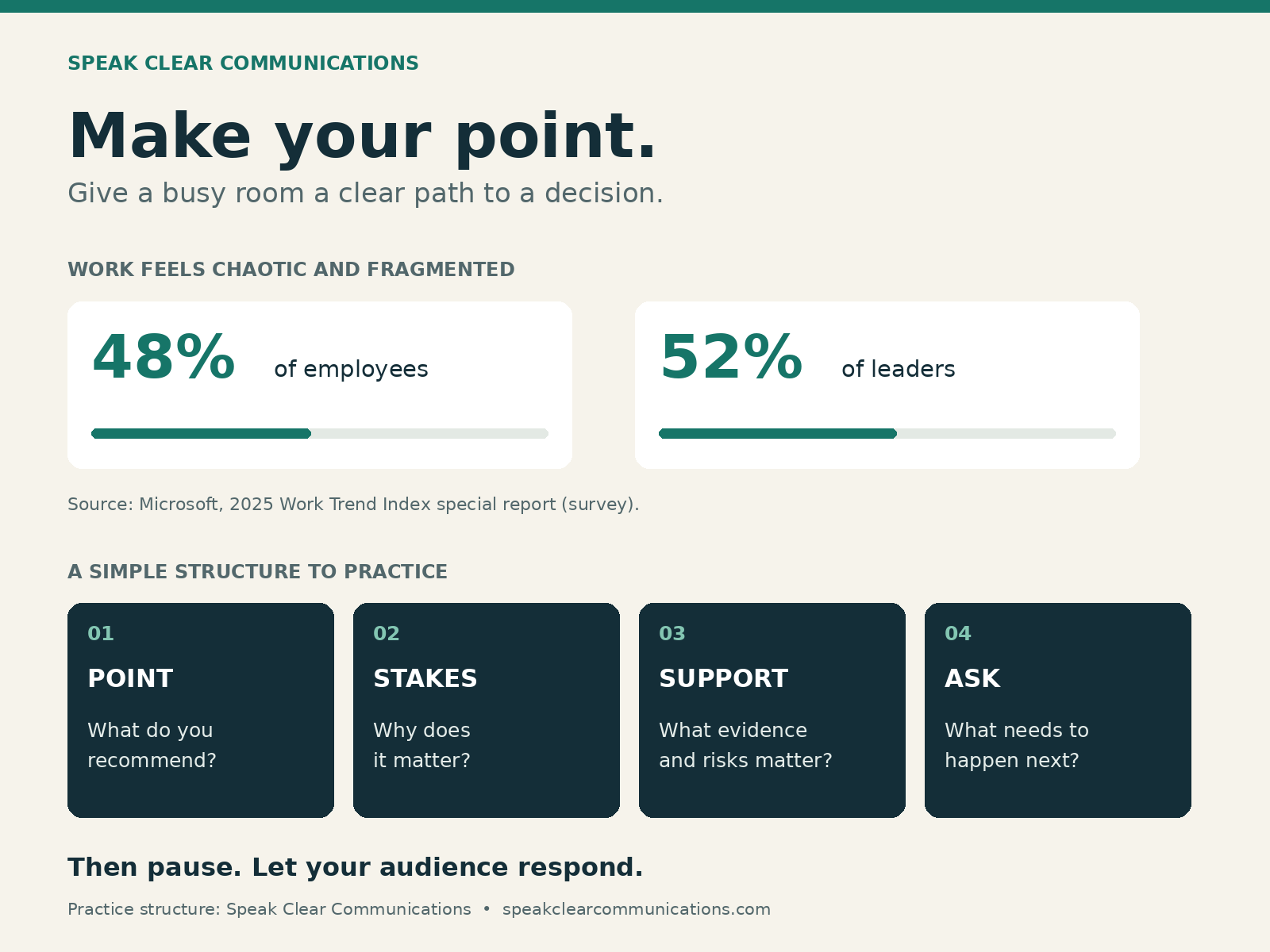
The workplace your message enters is crowded. Microsoft’s 2025 Work Trend Index special report reports that 48% of employees and 52% of leaders say their work feels chaotic and fragmented.
Meanwhile, Grammarly and The Harris Poll’s 2024 State of Business Communication report found that one in four knowledge workers surveyed reported miscommunications multiple times a day.
These studies describe broader workplace conditions; they do not establish that shorter presentations alone improve business results. But they give leaders a useful reason to make their messages easier to follow.
Workplace figures: Microsoft, 2025 Work Trend Index special report. The four-part speaking structure is a practice tool, not a finding from the study.
How can you speak more concisely in meetings?
Before you speak, ask yourself: What does this audience need to understand or decide? Build your answer around four elements:
- Point: State your recommendation, answer, or central message.
- Stakes: Explain why it matters to this audience.
- Support: Give the essential evidence, including a material risk or uncertainty.
- Ask: Specify the decision or next action you need.
This is a flexible structure. A routine update may need only two sentences. A sensitive decision may require a substantial discussion. Concision means giving each detail a purpose.
An example: presenting a recommendation to senior leaders
Here is a fictional example of an update that makes the listener work:
“We’ve been reviewing the rollout, and there have been several conversations with the operations team. There are a few training issues, although some locations are further along than others. We’re still looking at the schedule, and I think there might be a case for adjusting it.”
Here is the same situation with a clear recommendation:
“I recommend moving the launch back two weeks. Two locations still need training, and launching now could create service problems. The trade-off is a shorter selling window. Can we approve the revised date today?”
The second version gives the room something concrete to discuss. It also includes the downside. Executive presence depends partly on being willing to name the trade-off rather than bury it.
How do you sound confident without rushing?
Once the message is clear, work on how you deliver it.
Let the first sentence land. Finish your recommendation and pause briefly. Resist the impulse to fill every opening with another explanation.
Choose a phrase to emphasize. In the example above, “moving the launch back two weeks” carries the decision. Let your voice make that phrase easy to hear.
Finish words and thoughts. If your voice trails off at the end of an important sentence, practice carrying it through the final word at a comfortable volume. Clarity includes articulation as well as structure.
Keep your pace conversational. Trying to squeeze a long answer into a short slot often produces rushed speech. Remove unnecessary material before you speed up.
You do not need a louder personality to communicate with authority. You need a message your listeners can follow and enough room in your delivery for them to absorb it.
What if someone asks a question you did not prepare for?
Start by answering the question that was asked. If you need a moment, take it.
For a factual question, give the answer first and then the relevant qualification. For a recommendation, state your judgment and the reason behind it. When you do not know, say what remains unconfirmed and how you will follow up.
For example:
“I haven’t confirmed the implementation cost yet. I’ll check it with operations and send you a figure by Thursday.”
That is more useful than an extended answer that sounds certain but never resolves the question. Concise communication makes the limits of your knowledge clear, too.
A five-minute exercise for your next leadership meeting
Choose a real update you need to deliver this week.
Minute 1: Write the single sentence you want the audience to remember.
Minute 2: Add why it matters, one or two supporting details, and your request.
Minute 3: Record yourself delivering it aloud. Aim for roughly a minute as a practice constraint, not a universal rule.
Minute 4: Listen once. How long did it take to reach the point? Did you name the next step? Could a listener repeat your recommendation?
Minute 5: Record it again with one change: move the main point earlier, remove a detour, or add a pause.
Do not chase a flawless recording. Look for a message that becomes easier to understand.
Questions about executive communication coaching
Is concise communication the same as speaking briefly?
No. A brief answer can still be confusing or incomplete. Concise communication gives the listener the information needed to understand or act, without unnecessary detours. Important context, uncertainty, and empathy still belong in the conversation.
Can I build executive presence if I am naturally quiet?
Yes. You can work on clear recommendations, audible delivery, thoughtful pauses, and direct answers without adopting an extroverted style. The goal is to help your audience hear your judgment and understand your contribution.
What can an executive speech coach help me practice?
A coach can help you organize real presentations and meeting updates, hear habits that obscure your point, and rehearse delivery and questions. Depending on your needs, that work may include articulation, pacing, vocal presence, storytelling, and managing speaking nerves.
Make your next important conversation easier to follow
If your expertise is stronger than your delivery suggests, you can work on that.
At Speak Clear Communications, I help professionals develop clearer speech, stronger presence, and more effective presentations. We can work with the situations that matter to you: a leadership update, a client presentation, or the question you tend to over-explain.
Schedule a consultation with Jeffrey Davis, or email jeffrey@speakclearcommunications.com.
Jeffrey Davis is an executive speech coach and the founder of Speak Clear Communications. His background includes an MFA in acting from Rutgers University and work as a writer and filmmaker.